My Party Is Grinding Gear Synthesis and Pity Guide: Blacksmith Rates and Costs
Blacksmith gear synthesis rates from Common to Eternal, combining 9 same-grade items, the 10-failure pity rule, crafting Coin costs, and auto-combine priority.
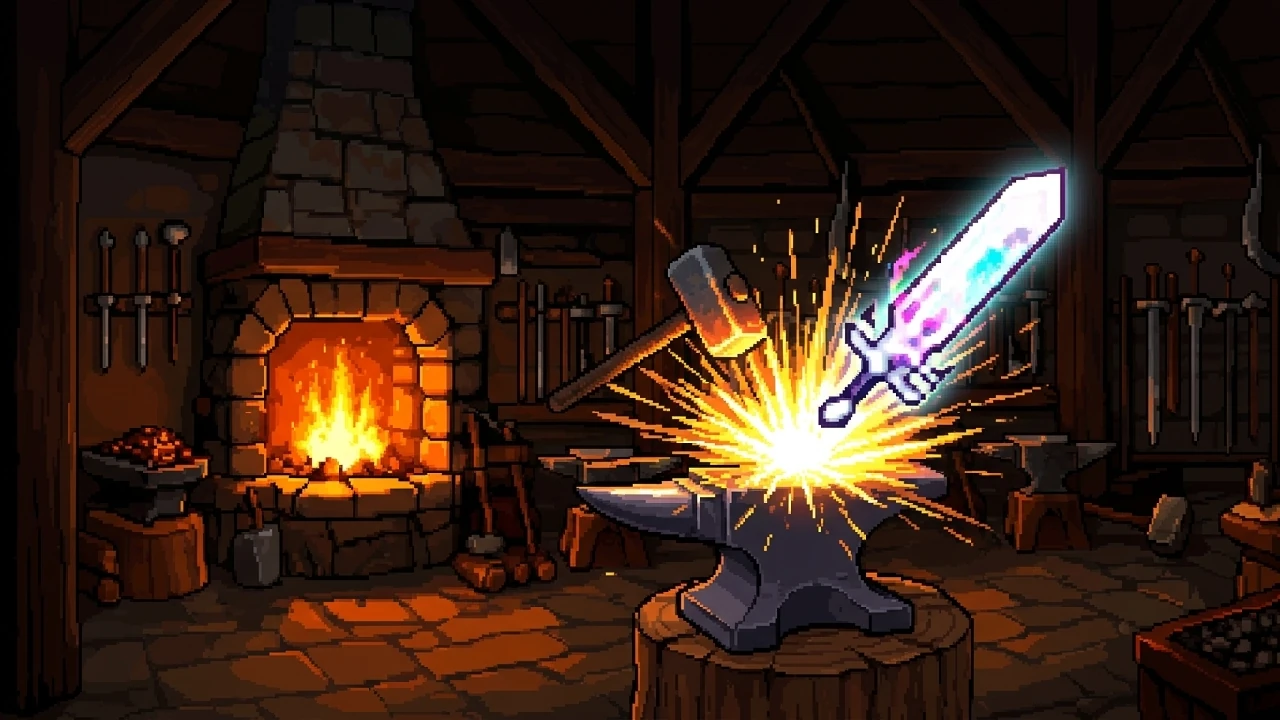
At the Blacksmith, gear synthesis merges 9 unequipped, unlocked equipment items of the same grade inside a chosen level band to try creating 1 piece of the next grade, while Eternal gear sits at the top grade and cannot be combined. Both successful and failed attempts consume all 9 inputs, but every failure gives back 1 new piece of the original grade; once you accumulate 10 failures within that same input grade and level band, your next combine upgrades automatically.
For the wider breakdown of equipment slots, base scaling, and trading eligibility, see our gear and crafting guide.
Synthesis success rates by Blacksmith level
From Blacksmith level 1 through level 50, every input grade uses its base upgrade probability: 90% for Common, Uncommon, and Magic, then stepping down to 60% for Rare, 40% for Epic, 20% for Legendary, and 10% for Mythic. Once your Blacksmith passes level 50, every extra level adds 0.5 percentage points to your combine odds up to full success with zero failures.
| Input grade | Output grade | Level 1–50 rate (%) | Level 100 rate (%) |
|---|---|---|---|
| Common | Uncommon | 90 | Full (no failures) |
| Uncommon | Magic | 90 | Full (no failures) |
| Magic | Rare | 90 | Full (no failures) |
| Rare | Epic | 60 | 85 |
| Epic | Legendary | 40 | 65 |
| Legendary | Mythic | 20 | 45 |
| Mythic | Eternal | 10 | 35 |
| Eternal | Cannot combine | — | — |
At Blacksmith level 100, the 50 bonus levels past level 50 lift Common, Uncommon, and Magic synthesis to full success (10,000 out of 10,000, leaving no failure roll), while Rare reaches 85, Epic reaches 65, Legendary reaches 45, and Mythic reaches 35 out of 100.
Keep two level-related details in mind before feeding higher-level spares into a combine:
- Input bands do not lock output level: A selected level band limits which items can enter the 9 slots, then applies a random shift around their average level and picks from fixed levels for that gear type, so even a successful combine can output a lower-level piece or choose valid gear outside the band if none exists for that result grade.
- Leveling the Blacksmith faster: Investing in
 Smelt Orb (8 nodes in Branch 7) and
 Verdant Resonance Orb (1 node in Branch 7) raises your Blacksmith and Mage Tower EXP rate so you reach the level 50 bonus threshold sooner.
How synthesis pity and worst-case item math work
When a gear combine fails, the Blacksmith consumes all 9 same-grade pieces and returns 1 newly rolled item of that same grade. Because you can drop that returned piece right back into your next batch of 9, a worst-case streak of 10 consecutive failures consumes 9 items minus 1 recycled piece on each miss before your 11th combine needs 9 inputs and upgrades automatically to 1 higher-grade piece.
Three rules govern how that failure counter behaves:
- Tracked per grade and band: The 10-failure counter is saved separately for each input grade and level band.
- Regular upgrades keep your progress: Ordinary successful combines do not reset your accumulated failure count, so every failed attempt permanently brings that grade and band closer to an automatic upgrade.
- Gear synthesis only: Material synthesis combines 9 identical gems, scrolls, or crafting materials (same-grade engraving materials may be mixed), upgrading Rare and below by 1 or 2 grades while Epic and above can fail and return 1 input; the 10-failure automatic upgrade applies only to gear, not materials.
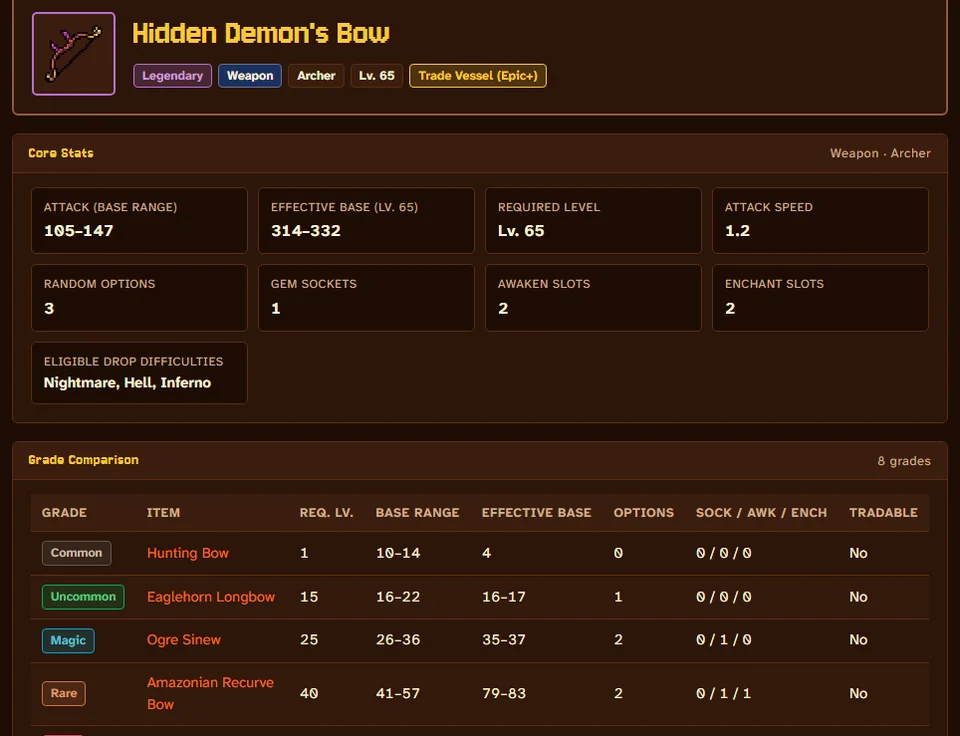
Across input grades, base synthesis success rates stay at 90% for Common, Uncommon, and Magic inputs, step down to 60% for Rare inputs (upgrading to Epic), and fall to 40% for Epic inputs (to Legendary), 20% for Legendary inputs (to Mythic), and 10% for Mythic inputs (to Eternal), with an automatic upgrade after 10 accumulated failures. For an Archer at level 65,  Hidden Demon’s Bow (Legendary, level band 61–80) brings 105–147 base Attack (314–332 effective Attack), 1.2 Attack Speed, 3 random options, 1 gem socket, 2 awaken slots, and 2 enchant slots; because only the top 4 grades (Epic and above) can be traded, hitting Epic or Legendary through synthesis also opens Trade Vessel eligibility. Once a combine yields a keeper piece, plan its extra stats with our enchanting and engraving guide and awakening guide.
Blacksmith crafting costs and gear progression
Instead of waiting on drops alone, the Craft tab at the Blacksmith lets you pick a Weapon, Armor, or Accessory category and a target grade unlocked by your Blacksmith level, spending Coins alongside grade-matched ores and special materials from the materials database. Accessory crafting unlocks starting at Magic grade, so Common and Uncommon crafts cover weapons and armor only.
| Grade band | Crafting cost (Coins) | Grade ingot |
|---|---|---|
| Common | 50 |  Bronze Ingot |
| Uncommon | 300 |  Iron Ingot |
| Magic | 1,200 |  Steel Ingot |
| Rare | 5,000 |  Platinum Ingot |
| Epic | 20,000 |  Mithril Ingot |
| Legendary | 80,000 |  Adamantium Ingot |
| Mythic | 250,000 |  Orichalcum Ingot |
| Eternal | 1,000,000 |  Infinium Ingot |
Alongside those grade ingots, Blacksmith recipes consume matching secondary crafting materials ranging from  Wood and
 Leather at Common up to
 Spark of Creation at Eternal, and each grade rolls inside its fixed result level range.
Comparing real Warrior axes from the gear database shows why climbing through synthesis and crafting transforms weapon output:
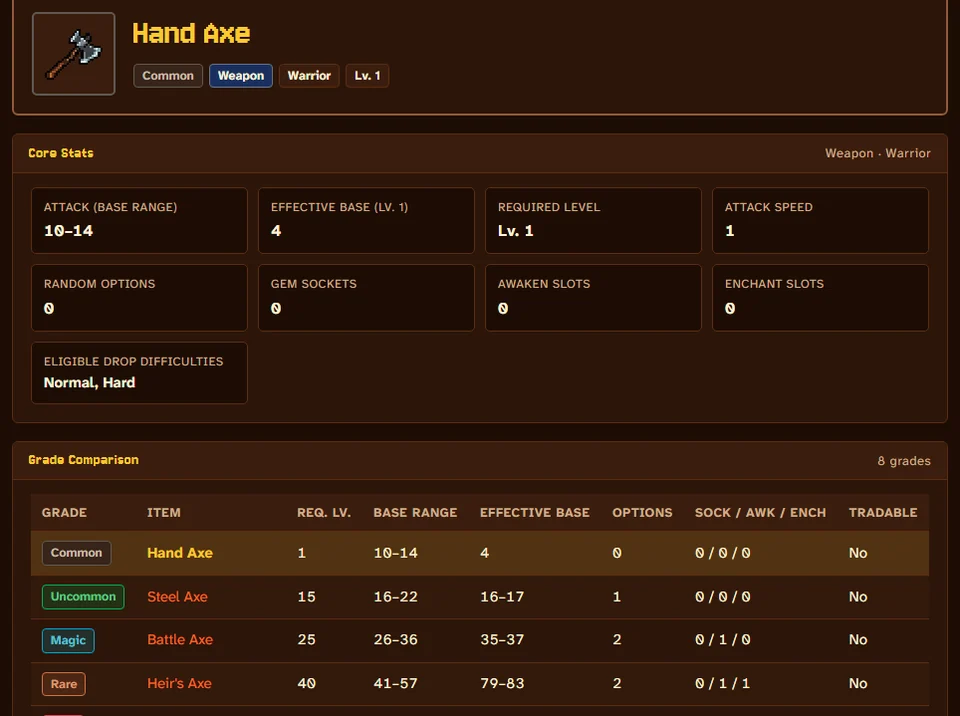
 Hand Axe (Common, level 1, Normal and Hard drops): 10–14 base Attack (4 effective Attack), 1 Attack Speed, 0 random options, 0 gem sockets, 0 awaken slots, 0 enchant slots, and untradable.
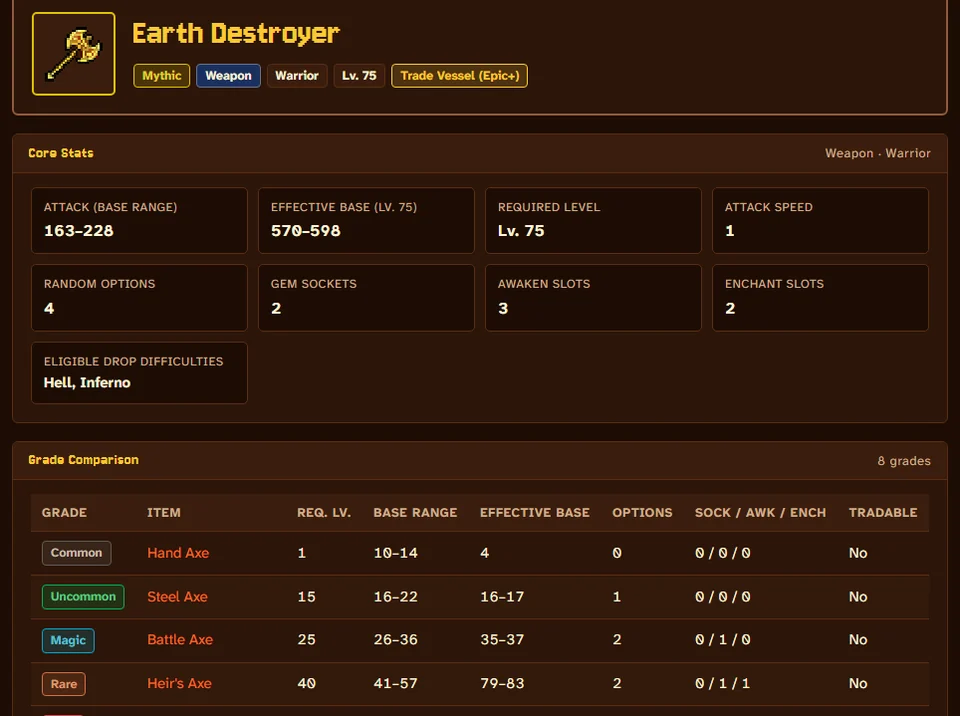
 Earth Destroyer (Mythic, level 75, level band 61–80, Hell and Inferno drops): 163–228 base Attack (570–598 effective Attack), 1 Attack Speed, 4 random options, 2 gem sockets, 3 awaken slots, 2 enchant slots, and tradable.
 Ancient Spirit’s Axe (Eternal, level 90, level band 81–100, Inferno drops): 260–365 base Attack (1,129–1,183 effective Attack), 1 Attack Speed, 4 random options, 2 gem sockets, 3 awaken slots, 2 enchant slots, and tradable; as an Eternal weapon, it cannot be synthesized further.
Because higher-grade gear drops and Blacksmith gear sale level caps expand as you push through campaign tiers, pair your forge schedule with the stage difficulties guide.
Auto-combine, overlapping bands, and auto-sell conflicts
Automation Pack owners can run auto-combine and auto-craft alongside auto-sell, following strict grade-boundary and bag-space rules:
- Identical odds across overlapping bands: Auto-combine matches manual synthesis odds and works downward from the top unlocked Blacksmith level band (overlapping ranges such as 30–50 and 45–65), triggering only once 9 same-grade items fill a batch while spare pieces stay eligible for the adjacent lower band.
- Auto-combine vs auto-sell priority: Auto-sell and auto-combine can never share the same grade. When you adjust one setting so the ranges collide, your latest change stays active and the other setting’s grade boundary shifts automatically.
- Automatic shutoff on full overlap: Setting auto-combine to begin at Common turns auto-sell off because no lower grade remains to sell, while raising the auto-sell ceiling until no input grade remains above it turns auto-combine off.
- Auto-craft bag and Coin guards: Auto-crafting builds higher grades first while respecting your minimum Coin balance and keeping 5 free bag slots; on the next sweep, newly crafted gear follows stash filing rules first before any items left in the bag enter auto-combine.