My Party Is Grinding Gear and Crafting Guide: Grades, Scaling and Upgrades
Complete breakdown of equipment grades, slot groups, native level scaling, drop bands, Mage Tower enhancements, Blacksmith synthesis, and Trade Vessel rules.
Equipment drives a large share of your party’s offense and survivability across the campaign, with 408 gear pieces distributed across 8 grades and 12 equipment slots. To see how equipment stats feed into each class’s overall combat pipeline, pair this reference with our classes and skills guide.
Contents
- Equipment slots and groups
- Grade unlocks and slot counts
- Native level scaling and weapon speed
- Difficulty drop bands and chests
- Mage Tower upgrade layers
- Blacksmith synthesis and crafting
- Trade Vessel listing rules
- Apocalypse gear expansion
Gear Structure and Slot Groups
All 408 equipment items share 152 grade profiles and span 8 grades from lowest to highest: Common, Uncommon, Magic, Rare, Epic, Legendary, Mythic, and Eternal. Those 12 equipment slots organize into three slot groups that determine which classes can equip an item and which enhancement stat pools apply.
- Weapon slots cover main weapons and off-hand items and are locked to one of the five playable classes: Knight, Warrior, Assassin, Archer, or Mage. Main weapons roll Attack as their base stat, while off-hand gear specializes by class, rolling Block for Knight, Attack Speed for Warrior and Archer, Critical Hit Chance for Assassin, and Cast Speed for Mage (as on
 Apprentice Spellbook).
- Armor slots cover six shared body pieces—helmets, body armor, gloves, belts, pants, and shoes—that any class can wear, drawing from Defense, HP, Attack Speed (on
 Cloth Gloves), and Mobility base stats.
- Accessory slots cover four shared jewelry pieces—rings, necklaces, earrings, and bracelets—available to any class starting at Magic grade (such as
 Copper Bracelet up to
 Abyssal Bracelet), with no Common or Uncommon variants.
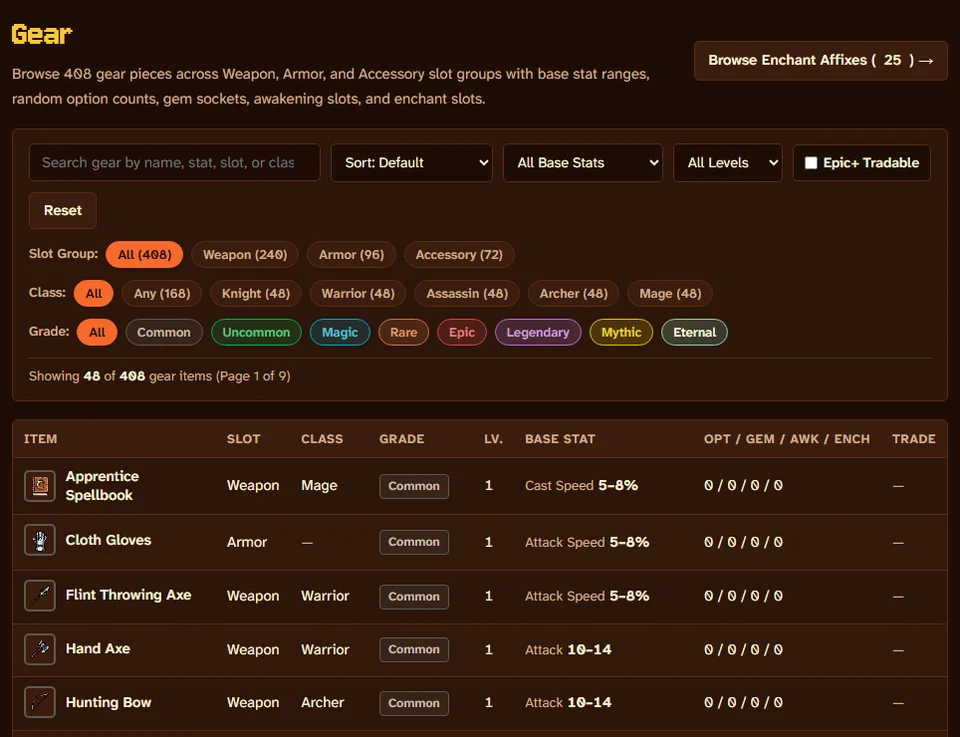
Filter by slot group, class, base stat, or tradability in the gear catalog to compare items within the same upgrade tier.
Grade Progression and Slot Unlocks
Higher grades raise an item’s base stat ceiling while opening additional random options, Mage Tower enhancement slots, and Trade Vessel access. Every equipment slot follows the same progression across all 8 grades, with engraving opening at Magic, enchanting at Rare, Trade Vessel trading at Epic, gem sockets at Legendary, and maximum slot capacity arriving at Mythic.
| Grade | Random options | Gem sockets | Engraving slots | Enchant slots | Trade Vessel |
|---|---|---|---|---|---|
| Common | 0 | 0 | 0 | 0 | No |
| Uncommon | 1 | 0 | 0 | 0 | No |
| Magic | 2 | 0 | 1 | 0 | No |
| Rare | 2 | 0 | 1 | 1 | No |
| Epic | 3 | 0 | 2 | 1 | Yes |
| Legendary | 3 | 1 | 2 | 2 | Yes |
| Mythic | 4 | 2 | 3 | 2 | Yes |
| Eternal | 4 | 2 | 3 | 2 | Yes |
At both Mythic and Eternal grades, items share identical counts of 4 random options, 2 gem sockets, 3 engraving slots, and 2 enchant slots, so the jump from Mythic to Eternal is driven by base stat scaling and higher native levels rather than extra sockets.
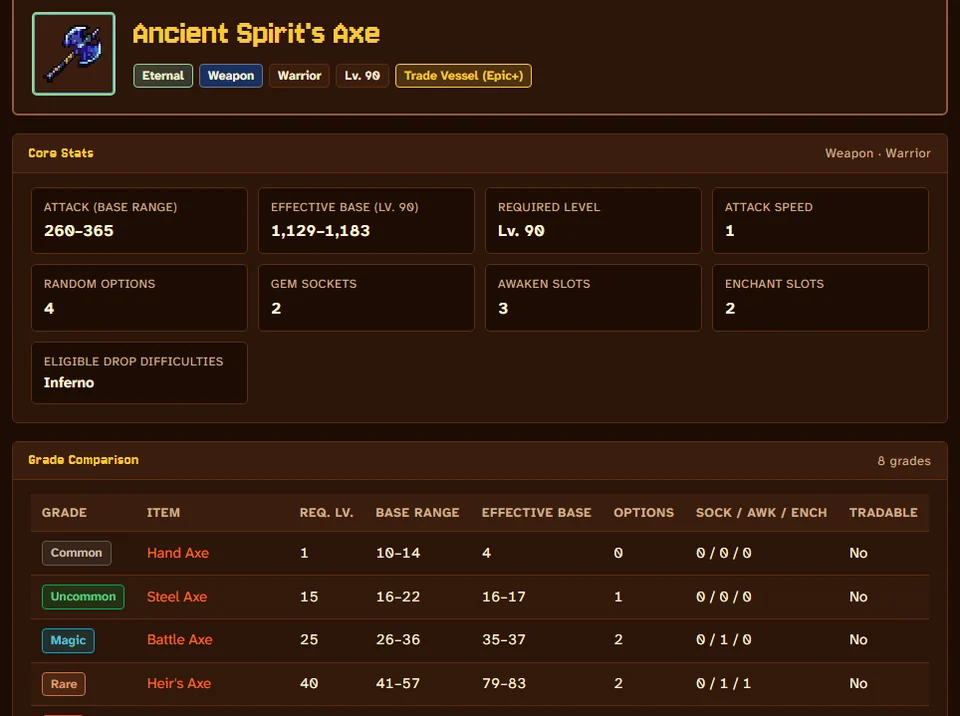
The Warrior main axe line illustrates this full climb across all eight tiers:  Hand Axe (Common, level 1, base Attack 10–14, effective Attack 4),
 Steel Axe (Uncommon, level 15, effective Attack 16–17),
 Battle Axe (Magic, level 25, effective Attack 35–37),
 Heir’s Axe (Rare, level 40, effective Attack 79–83),
 Axe of Fury (Epic, level 50, effective Attack 154–162),
 Mithril Axe (Legendary, level 65, effective Attack 314–332),
 Earth Destroyer (Mythic, level 75, effective Attack 570–598), and
 Ancient Spirit’s Axe (Eternal, level 90, base Attack 260–365, effective Attack 1,129–1,183).
Base Stat Scaling and Native Level Ladder
Each dropped or crafted gear item carries a native level that maps to the nearest rung on a shared ladder running from level 1, then 5 and 10, stepping up to level 100; on a tie between two rungs, the lower rung wins. The offline item generator rolls an item’s unscaled base stat uniformly within its grade profile’s base range (while the online server’s roll distribution is not visible), and that normalized roll position from 0 to 1 projects onto the profile’s effective base range at the matching ladder rung.
For instance, the Common weapon  Longsword for Knight at level 1 rolls within base Attack 10–14 and projects to 4 effective Attack, while
 Flame Longsword (Epic, level 50) rolls within base Attack 66–92 and scales to 154–162 effective Attack.
Option Scaling and Flat Coefficient Ladder
Intrinsic random options scale their grade range by a level coefficient before applying the same roll projection. Flat attack and HP options follow a piecewise-linear level coefficient ladder across levels 1 through 100, while Defense options and percentage-based options each apply their own rung multipliers.
| Native level | Flat attack and HP coefficient |
|---|---|
| 1 | 0.35 |
| 10 | 0.7 |
| 20 | 1.0 |
| 40 | 1.65 |
| 60 | 2.35 |
| 80 | 3.2 |
| 100 | 4.2 |
Unlike base stats and intrinsic options, stat values granted by socketed gems, engravings, and enchants already roll inside their final ranges and add directly without an extra level multiplier.
Weapon Attack Speed Override
Every class begins with a baseline Attack Speed of 1 before equipment is evaluated. Equipping any main weapon with a positive Attack Speed replaces that baseline 1 instead of adding to it, and percentage Attack Speed bonuses from passives, options, orbs, constellations, relics, or Fate multiply the resulting weapon speed up to the overall cap of 2.4.
| Class | Example main weapon | Weapon attack speed |
|---|---|---|
| Knight class | Longsword |
0.9 |
| Warrior class | Ancient Spirit’s Axe |
1 |
| Mage class |  Sturdy Staff |
1.1 |
| Archer class |  Hunting Bow |
1.2 |
| Assassin class |  Small Dagger |
1.4 |
Plug weapon swaps and enhancement rolls into the stats calculator to compare final attack speed and unit power before investing materials.
Difficulty Drop Windows and Chest Rules
Gear obtained from battle chests obeys two simultaneous filters based on the stage’s difficulty: a native level window and an allowed grade window. Pushing into higher difficulties therefore raises both the maximum rarity you can pull and the native level rungs available for base stat scaling.
| Difficulty | Native level window | Allowed gear grades |
|---|---|---|
| Normal | 1–15 | Common–Rare |
| Hard | 20–35 | Common–Epic |
| Nightmare | 40–55 | Uncommon–Legendary |
| Hell | 60–75 | Magic–Mythic |
| Inferno | 80–100 | Rare–Eternal |
Within each difficulty, later acts shift the target native level upward along the ladder—for example, stage 1 of Normal targets level 1, stage 40 of Normal targets level 15, stage 1 of Nightmare targets level 40, and stage 40 of Inferno targets level 100.
Chest type controls accessory drops and band weighting:
- Normal chests use elevation 1 and pull from non-accessory slots only.
- Stage Boss chests use elevation 2 and carry a 5% chance to roll an accessory slot.
- Act Boss chests use elevation 3 and carry a 30% chance to roll an accessory slot.
When the accessory roll triggers, the chest filters the difficulty’s grade pool to at least Magic (tier 3) before picking a grade—so accessory rolls never select Common or Uncommon—and falls back to a non-accessory gear piece only if no accessory candidate exists in that difficulty’s native-level window for the picked grade. While these chest contents follow the rules above, the probability that a defeated monster drops a chest in the first place is resolved server-side. Check chest probabilities per stage with the drop finder or plan your climb in the stage difficulties guide.
Mage Tower Enhancement Systems
Once you pull a piece with solid native level and random options, the Mage Tower provides three independent upgrade layers—gem socketing, engraving, and enchanting—plus a removal tab. Removing an existing enhancement at the Mage Tower costs Coins and never refunds the spent gem, engraving material, or scroll.
Sockets and Gems
Gem socketing opens on Legendary gear (1 socket) and expands to 2 sockets on Mythic and Eternal gear. The game features 10 gem families across 8 grades (80 gem tiers in all):  Ruby,
 Sapphire,
 Topaz,
 Emerald,
 Amethyst,
 Obsidian,
 Pearl,
 Jade,
 Garnet, and
 Opal.
Socketing spends 1 gem, costs no Coins, and has no failure roll, rolling a value inside that gem tier’s range for the fixed stat matching the gear’s slot group. For example, Ruby grants Elemental Damage in Weapons, Fire Resistance in Armor, and Skill Hit Range in Accessories, while Opal grants Additional Damage in Weapons, Damage Reduction in Armor, and Skill Duration in Accessories. Compare all ten gem families in the gems catalog and read socketing priorities in our gems and sockets guide.
Engraving and Awakening Materials
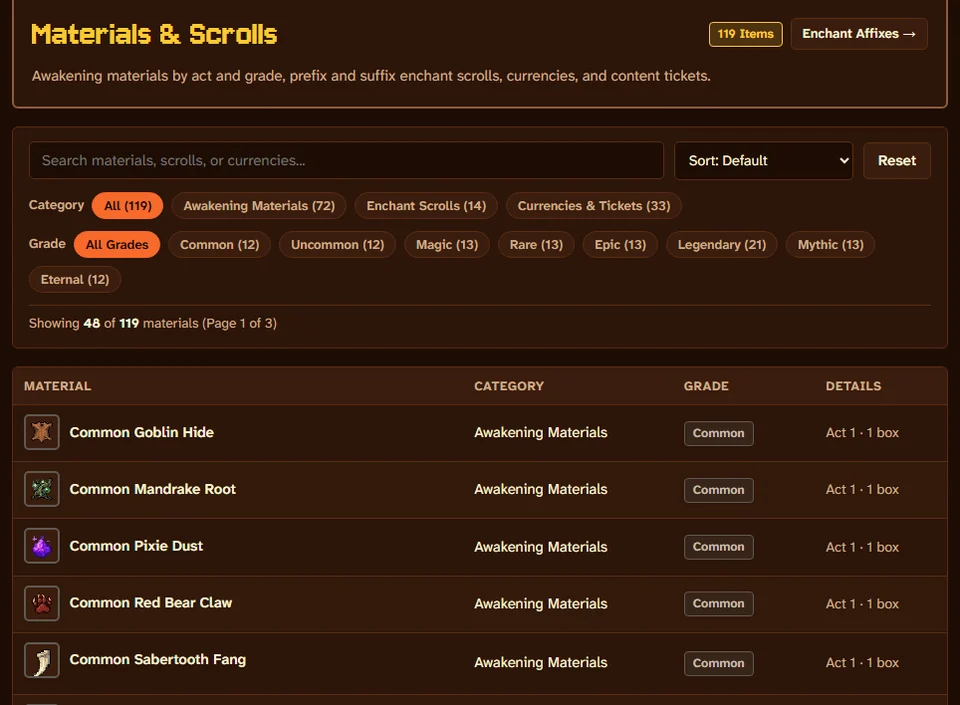
Engraving opens at Magic grade (1 slot on Magic and Rare, 2 slots on Epic and Legendary, and 3 slots on Mythic and Eternal). There are 72 Awakening Materials—part of the 119 cataloged items in the materials directory—distributed across acts 1 through 4, such as  Common Goblin Hide,
 Magic Bloodwolf Fang, and
 Epic Black Calamity Shard.
Chest drops remap engraving material acts by difficulty: Normal drops act 1, Hard drops acts 1–2, Nightmare drops acts 2–3, Hell drops acts 2–4, and Inferno drops acts 3–4. Each Awakening Material lists 2 candidate stats per slot group (Weapon, Armor, and Accessory) and picks one by weight; engraving consumes 1 material, costs no Coins, and never fails. See every material’s stat pair and act source in the awakening guide.
Enchanting and Risk Enchant
Enchanting unlocks on Rare gear (1 slot on Rare and Epic; 2 slots on Legendary, Mythic, and Eternal). Scrolls split into prefix Epithet Scroll items (such as Uncommon Epithet Scroll and Legendary Epithet Scroll) and suffix Title Scroll items (such as Eternal Title Scroll) spanning grades 2 (Uncommon) through 8 (Eternal), drawing from 25 affixes listed in the enchant affixes directory.
An item can hold at most one prefix and one suffix; overwriting an existing prefix or suffix requires removing it at the Mage Tower first, and adding the opposite type requires an open enchant slot. Base enchant success starts at 90% for an Uncommon scroll (grade 2) and drops by 5 percentage points per scroll grade down to 60% for an Eternal scroll (grade 8).
Leveling the Mage Tower improves enchant odds starting at level 3: each level adds 0.5 percentage points, up to +14 percentage points at level 30. Regular enchanting has a 0% chance to destroy the gear on failure—only the scroll is lost while the gear and its existing stats remain untouched.
Enabling the optional Risk Enchant checkbox requires a Legendary or higher scroll and unequipped gear, leaves the success rate unchanged, and widens both ends of the stat roll range by 30% on Legendary scrolls, 35% on Mythic scrolls, and 40% on Eternal scrolls. In exchange for that expanded range, a failed Risk Enchant carries a 50% chance to permanently destroy the gear and every enhancement on it. Check affix weights and scroll ranges in the enchanting and engraving guide.
Blacksmith Synthesis and Band Crafting
At the Blacksmith, you convert surplus drops and crafting stock into higher-grade equipment through two primary tabs: synthesis and crafting.
Gear Synthesis and 10-Failure Pity
Gear Synthesis combines 9 unequipped, unlocked items of the same grade within your selected Blacksmith level band. On success, all 9 items fuse into 1 piece of the next grade; on failure, all 9 inputs are still consumed and you receive 1 new piece of the same grade. Eternal gear sits at the top of the current ladder and cannot be synthesized.
Base success rates start at 90% for Common, Uncommon, and Magic inputs and step down across higher grades, while Blacksmith levels above 50 up to level 100 add 0.5 percentage points per level. After 10 accumulated failures on the same input grade and level band, the next synthesis succeeds automatically and upgrades the grade; normal successes do not reset this failure counter.
Material Synthesis also merges 9 identical gems, scrolls, or crafting materials—or 9 same-grade engraving materials mixed together—into 1 result, though the 10-failure upgrade protection applies to gear synthesis only.
Band Crafting Costs and Accessory Gate
Band crafting builds a piece for your chosen slot category and grade by spending Coins alongside grade ores and special materials (from  Bronze Ingot at Common up to
 Infinium Ingot and
 Spark of Creation at Eternal). Crafting accessories at the Blacksmith begins at Magic grade, matching the drop pool rule.
| Input or craft grade | Base synthesis (%) | Blacksmith level 100 (%) | Band craft Coin cost |
|---|---|---|---|
| Common | 90 | Maximum | 50 |
| Uncommon | 90 | Maximum | 300 |
| Magic | 90 | Maximum | 1,200 |
| Rare | 60 | 85 | 5,000 |
| Epic | 40 | 65 | 20,000 |
| Legendary | 20 | 45 | 80,000 |
| Mythic | 10 | 35 | 250,000 |
| Eternal | — | — | 1,000,000 |
See full level-band breakdowns and auto-synthesis rules in our synthesis and pity guide.
Trade Vessel Deposit and Market Rules
Players trade surplus high-tier gear and crafting stock on the Steam Community Market through the Trade Vessel. For gear, Epic grade and higher (the top 4 grades) qualifies for deposit, whereas materials of any grade can be deposited; materials move in stacks of 5, while a  Coin Chest trades one chest at a time.
Before depositing eligible gear, make sure it is unequipped, unlocked, and stripped of every enhancement: any engraving, enchant, or gem must be removed at the Mage Tower first. Gear bought on the Steam Community Market binds to your inventory upon claiming and cannot be resold.
Every account unlocks 4 free Trade Vessel selling slots—2 immediately on first login and 2 more after 7 days (one week)—while the Market Slots Pack adds 4 extra slots for up to 8 concurrent deposits. Once an item is deposited or listed, its slot stays reserved for 12 hours from listing or deposit even if the item sells early, and withdrawals remain locked for 12 hours after deposit.
Upcoming Apocalypse Gear Expansion
An announced update introduces the Apocalypse difficulty (unlocked by clearing Inferno 4-10) and raises the hero level cap to 120. Alongside the new difficulty, the expansion adds 54 new gear items ranging from level 105 to 120 and introduces the Ascendant rarity above Eternal.